Use the framed size when measuring your wall space.
SOLD OUT. This edition was super popular and is now completely sold out. Be the first to hear about new artworks and get early access — sign up now and follow the artist.
CUT-OUT
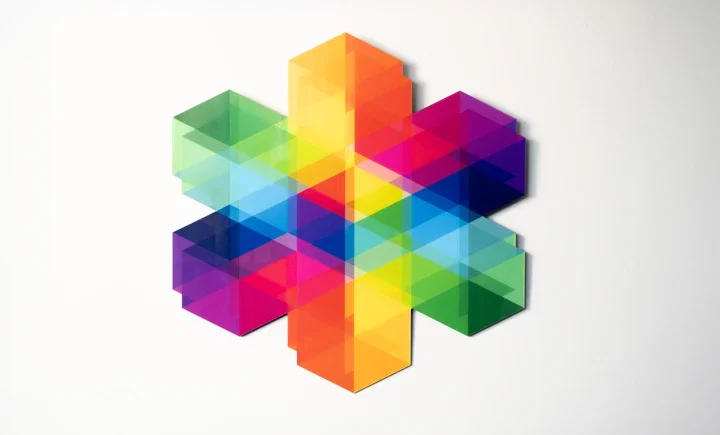
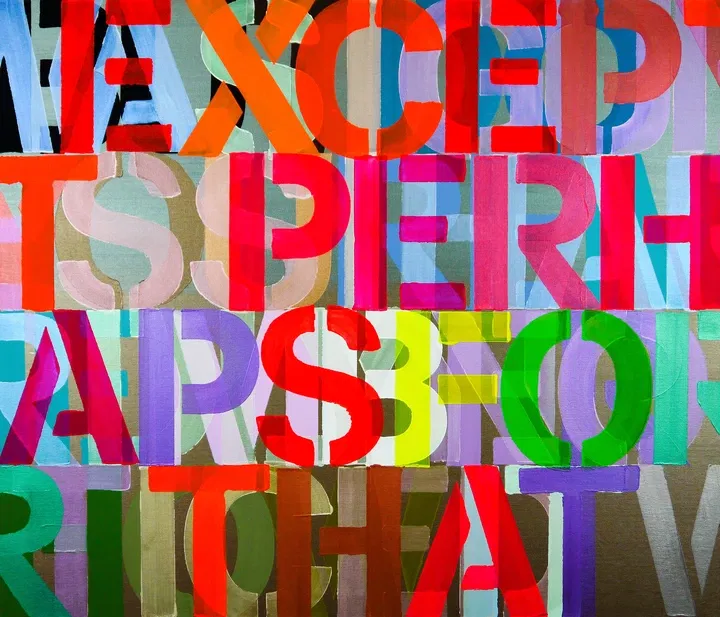
In Darko C. Nikolić’s cut-out works, geometric abstraction becomes a spatial experience: color, form, and structure interact with striking precision, making perception itself an integral part of the composition.
Wall Object Cut-Out Mounted under Acrylic Glass, 2mm glossy
Darko C. Nikolić’s works unfold at the intersection of geometric abstraction, perception, and spatial construction. Color and form operate as precisely placed impulses through which visual order emerges in the viewer’s eye. The image…
In Darko C. Nikolić’s work, geometric abstraction becomes an experiential space: color, form, and structure create precise impulses that guide the eye and activate spatial relationships. Between constructive rigor and sensory impact, perception itself becomes an event.
BACKGROUND INFORMATION
Darko C. Nikolić’s works unfold at the intersection of geometric abstraction, perception, and spatial construction. Color and form operate as precisely placed impulses through which visual order emerges in the viewer’s eye. The image is understood not merely as a surface, but as a space of experience—one in which the structuring and direction of perception itself can be observed.
Nikolić describes his practice as introspective constructivism. For him, geometric systems are never ends in themselves, but instruments for making perceptual processes visible. Lines, planes, clear structures, and contrasts generate tensions that guide the gaze, focus it, and activate spatial relationships within the act of looking.
A key element of his work is the deliberate use of primary colors, recalling Bauhaus-adjacent color theories such as Itten’s color wheel, in which color functions as an ordering principle. Contrast, dynamism, and visual direction are not produced illustratively, but constructively.
Nikolić’s works build a precise bridge between art-historical rigor and immediate visual impact. Constructive spatial concepts and axonometric thinking, as found for instance in Theo van Doesburg, meet impulses drawn from Op Art, setting perception in motion: planes tilt, forms begin to vibrate, perception becomes event. It is at this intersection that the distinctive quality of his work emerges—between calculation and sensuousness. A precision that not only permits perception, but actively co-authors it.
In collaboration with LUMAS, wall objects and sculptures now enter into a direct dialogue. What might previously have been described in theoretical terms as an “unfolding of space” becomes aesthetically tangible: space opens up between object and surface, and the interplay of color, form, and structure becomes sensorially legible. Nikolić makes visible how three-dimensional construction is translated into the plane—and presents perception as an active process: a mode of seeing that follows, shifts, completes, and composes.
INTERVIEW
Picasso once said: “You don’t make art, you find it.” Where do you find your art?
I often feel rather that my art has found me. My work arises less from the idea of inventing something than from the attempt to make something visible that already exists. Sometimes it feels as if I am uncovering or revealing things - not inventing them.
From idea to realization: How do you approach your work?
My work follows the “Circle of Exploration and Creation.” Series of works pose questions about perception, while research cycles investigate these questions through comparable image series. From these insights, new series of works emerge. In this way, my practice develops as an ongoing cycle of exploration, analysis, and artistic condensation.
Your favorite book?
Concerning the Spiritual in Art by Wassily Kandinsky. It is one of the rare books that not only speaks about art, but about why art is necessary in the first place.
Which artist would you like to have coffee with, and what would you talk about?
I would love to sit with a coffee in Josef Albers’ class at Black Mountain College and simply listen.
I am particularly interested in how he made perception and color tangible through precise exercises.
How did you come to art?
At 13, I discovered graffiti. The fascination with visual creation has never left me since - it has only changed its form over the years.
Which people around you influence you?
I regularly work with a group of German artists who exhibit in China under the curatorial direction of Ren Rong.
Since I am the youngest in the group, it is very valuable for me to learn from the experiences of the others while continuing to develop my own position.
Imagine you had a time machine. Where would you go?
To the Bauhaus in Weimar. I would be interested in seeing how art, design, and thinking influenced each other there.
Your greatest passion outside of art?
Sport. Basketball is a good physical and social balance for me alongside the concentrated work in the studio.
What are you currently working on?
On further deepening and refining my artistic position - both through new series of works and through research cycles that continuously develop my practice.
LUMAS ART NEWS
Exclusive offers
Inspiring new releases
Personal invitations to Art Events
LUMAS protects your data. See our Privacy Policy for details.
ALMOST DONE ...
1. Open the confirmation mail.
2. Click on the confirmation link.
3. Your wishlist registration was successful!
4. Your wishlist has been saved!
We look forward to welcoming you soon to the world of LUMAS.
DIGITAL PREVIEW
SCAN THE QR CODE! (Safari IPHONE ONLY)
PREVIEW ON YOUR WALL
SCAN THE QR CODE! (Safari IPHONE ONLY)
90% of our customers order mounting or framing for a perfect gallery look.
Fully protected by our 30 day return policy.
Ready to Hang.
Elevates the artwork to true gallery quality.
Continue without mounting or framing?
* Rolled prints are final sale and cannot be returned or retrofitted with our frames
PREVIEW ON
YOUR WALL
SAFARI ONLY. ABOUT 3 METERS DISTANCE.
PRESS START.




 About Darko Caramello NikolićDarko C. Nikolić’s works unfold at the intersection of geometric abstraction, perception, and spatial construction. Color and form operate as precisely placed impulses through which visual order emerges in the viewer’s eye. The image…
