Use the framed size when measuring your wall space.
SOLD OUT. This edition was super popular and is now completely sold out. Be the first to hear about new artworks and get early access — sign up now and follow the artist.
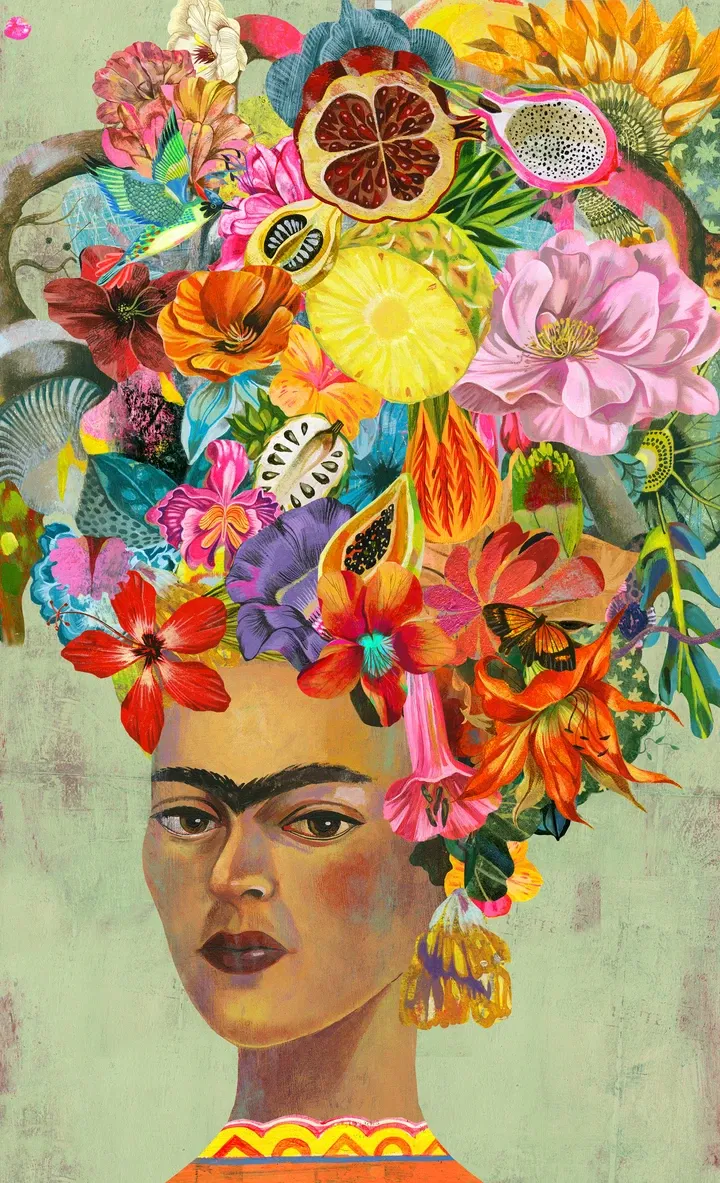
Claudia Sauter’s women do more than fill the canvas — they claim their space. Through intense colours and tightly framed close-ups, the Swiss artist presents femininity as a self-defined presence: powerful and vulnerable, extroverted and introspective, individual rather than idealised. Her portraits are therefore less concerned with physical likeness than with the elusive quality that makes a person unmistakably themselves. “I don’t paint faces. I paint presence,” Sauter says, summing up her approach.
Her work begins with close observation. Encounters, gestures, moods and fleeting moments become the material of her art. She is particularly drawn to what remains unspoken: the tension between strength and vulnerability, presence and withdrawal. Sauter translates these impressions into a visual language in which expression and bearing matter more than likeness alone. A glance, the tilt of a head or the way a figure engages the viewer can become the true centre of a work.
Colour plays a defining role. Pink, electric blue, bright yellow, orange or turquoise do more than adorn her figures; they shape their character. “Colour is not decoration — it is identity made visible,” Sauter explains. At times, saturated fields of colour meet along clear boundaries; at others, gestural marks break up the precise contours. This creates a tension between graphic clarity and painterly freedom, between controlled composition and emotional directness.
This combination is closely interwoven with Sauter’s own biography. Before her independent artistic practice took centre stage, she spent many years working in marketing and communications, engaging closely with advertising design, interior design, branding and visual communication. Her instinct for strong visual messages does not disappear in her painting — it finds greater freedom. Under the name Poptonicart, she combines influences from everyday life, advertising, design, business and contemporary visual culture in a vividly coloured Pop Art language.
While historical Pop Art often centred on consumer culture, products and media imagery, Sauter directs her discerning gaze above all towards people — and towards the modern woman in particular. Her portraits explore identity, self-determination and visibility. Rather than embodying a single conception of femininity, her women appear in different roles, moods and forms of expression. This complexity is central to Sauter’s work: she is interested in individuality within the images shaped by society — and in how personality can assert itself without being confined to a single definition.
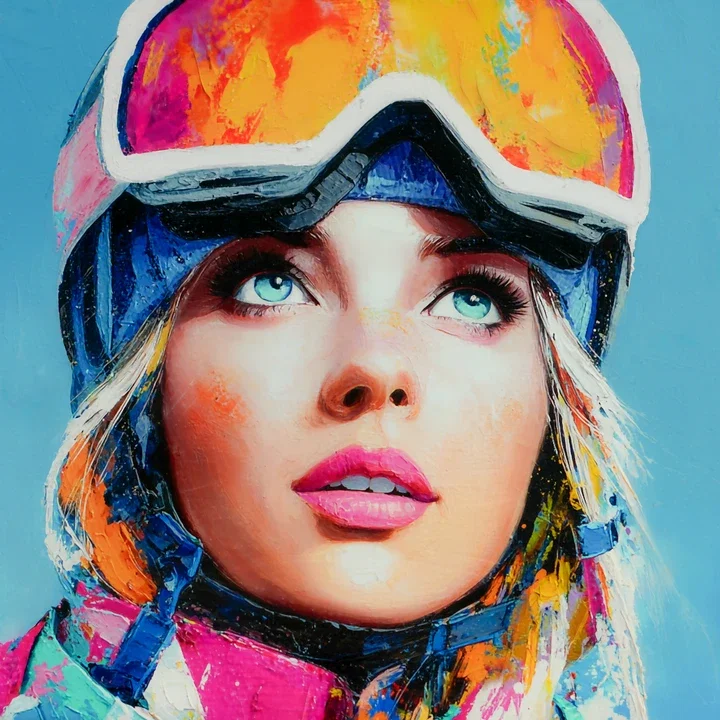
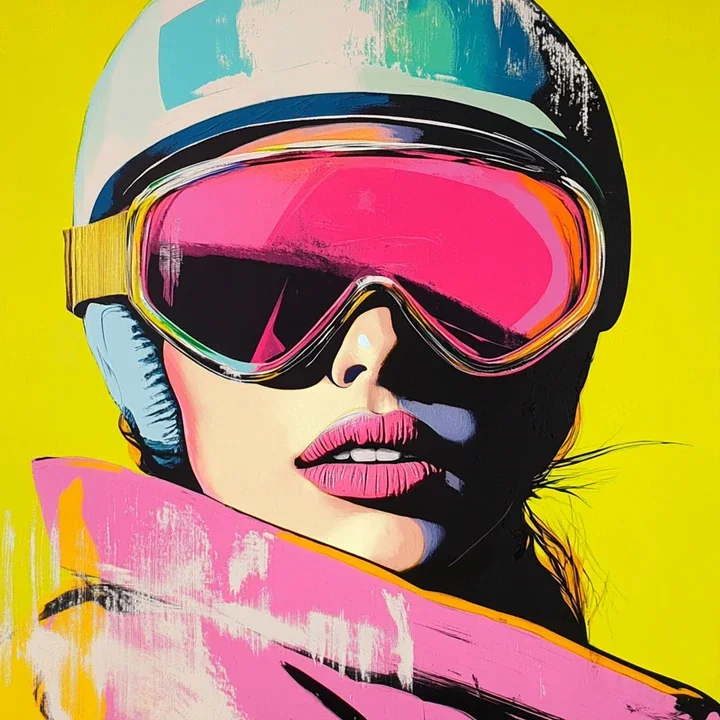
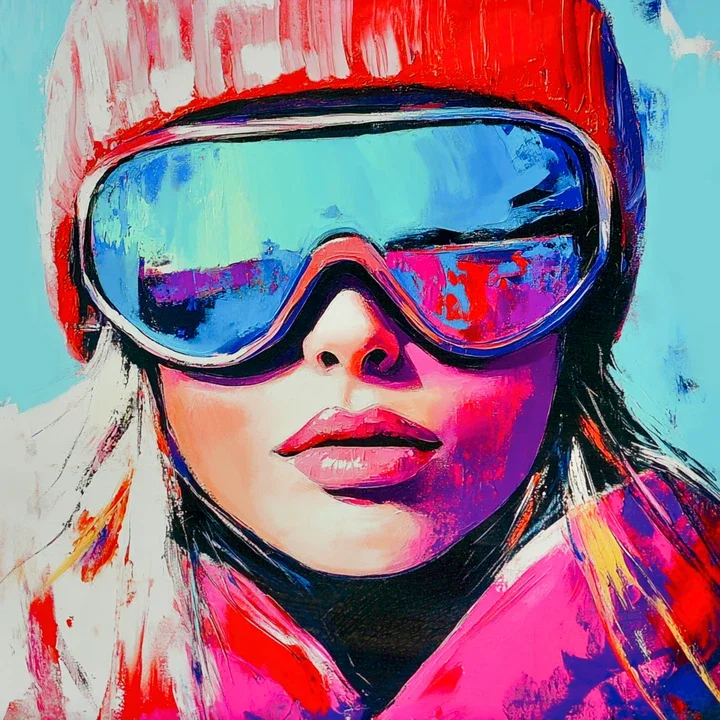
In her Skiing in the Mountains series, this idea takes a particularly dynamic form. The series connects movement, altitude and freedom with Sauter’s central theme of female self-determination. Her protagonists wear ski helmets and oversized goggles that sometimes conceal much of the face. This gives the visible details all the more weight: the mouth, the angle of the head, an upward gaze. The goggles also become a field of colour within the image — mirror, shield and graphic focal point.
In works such as Skiing Fashion, Skiing in the Blue, Skiing Red and Skiing Pink, bold fields of colour meet painterly textures and striking contours. The mountains themselves need scarcely appear for their presence to be felt. Instead, the series focuses on the feeling associated with them: speed meets control, energy meets concentration, athletic strength meets elegance.
This is precisely what gives the ski series its natural place within Sauter’s wider body of work. Here, movement becomes an image of self-determination. The figures appear composed, focused and free — as though their posture already held the momentum of the descent. Sauter shows not simply women taking part in a sport, but women in a moment of focused independence. Their presence emerges not despite the equipment that conceals them, but precisely through it.
Her current exploration of contemporary femininity in Switzerland develops this idea further. Sauter turns her attention to women across different professions, pursuits and ways of life, deliberately bringing their strength, individuality and beauty to the fore. Her interest lies less in an ideal image than in the diversity of female identity — and the many ways in which presence can become visible.
Claudia Sauter’s art is bold in colour, yet goes beyond the surface. Her palette draws the eye, but the real subject lies deeper: in the question of how personality becomes visible. Her portraits offer no universal answer. Instead, they show that presence begins where a person is not merely seen, but asserts themselves.
VITA
Claudia Sauter is a Swiss Pop Art artist who lives and works in Küsnacht, near Zurich. Her design education began at the Neue Kunstschule Zürich, where she studied advertising design from 1994 to 1997. She then trained in interior design from 1998 to 2000. Later, she deepened her knowledge of design, art, and arts and heritage management.
Sauter spent many years working in marketing and communications for international companies. Today, she brings this experience in branding, visual communication and strategic design to her independent artistic practice. Under the name Poptonicart, she develops a distinctive, intensely coloured visual language at the intersection of Pop Art, portraiture and contemporary visual culture.
Her work centres on portraits of women that explore identity, presence, movement and self-determination. She works primarily with painting and combinations of printing and mixed-media techniques, continually developing her themes across different series.
INTERVIEW
Picasso said: “You don’t make art, you find it.” Where do you find your art? I find my art above all in people — in their presence, in their gazes, in moments that often remain unspoken. I’m interested in the space in between: the tension between strength and vulnerability, presence and withdrawal. I spend a great deal of time observing and translate what I perceive into colour and form.
From the initial idea to the finished piece: how do you approach your work? My life and everyday experiences are my most important source of inspiration. Encounters, observations, moods — often, it’s the small moments that provide the spark. Women are at the centre of my work. I encounter them everywhere — in my own circle, in public spaces, in fleeting moments of observation. I draw on these impressions and deliberately place them at the heart of my paintings. These observations give rise to an initial, often very intuitive idea. From there, the work develops step by step: colours, expression and composition respond to one another and shape the presence of the finished piece. I don’t follow a rigid plan, but leave room for the work to evolve — with a clear sense of the effect and presence I want the finished painting to have. Your greatest passion outside art? I’m interested in people, systems and the connections between things. This curiosity shapes many aspects of my life — and it also shaped my earlier work in strategy. I enjoy understanding things and putting them into context. At the same time, design and nature play an important role in my life. Design for its clarity and aesthetics, nature for its calm and effortless presence — to me, they are powerful counterpoints that inspire me and keep me grounded.
How did you find your way to art? Art has always been a part of me, although for a long time it wasn’t at the centre of my life. I initially pursued a conventional career in marketing and communications, where creativity was present, but within a structured framework. At some point, the desire to express myself more freely and personally grew stronger. Painting gave me precisely that opportunity — to make themes such as identity, presence and emotion directly visible. What began as a parallel pursuit gradually became a central part of my life and work.
Which artist would you like to have coffee with — and what would you talk about? Jeff Koons. I’m fascinated by the way he connects art, commerce and perception, and by the clear, powerful visual language he has developed in doing so. I would talk to him about how he manages to balance emotion, surface and meaning in his work — and about how art positions itself today between aesthetics, the market and social relevance.
Which people around you influence you? I’m inspired by people who follow their own path and have a clear sense of what they stand for. They aren’t necessarily public figures; often, they are people in my immediate circle who make an impression through their presence and authenticity. My family plays a particularly important role. They are an important anchor for me — and also a source of inspiration, because family is where closeness, trust and authentic personalities come together.
Imagine you have a time machine. Where would you go? I’d like to travel to different eras — not so much out of nostalgia, but to understand how perception, ideas about social roles and aesthetics have changed. I’d be particularly interested in periods of transition, when something new is taking shape in society.
What are you working on at the moment? I’m currently working on new portrait series exploring contemporary femininity and identity. As a Swiss artist, I’m particularly interested in the subject of women in Switzerland. I’m exploring ways to make women visible in their different roles — in various professions and activities, as well as in their personal passions. For me, this is not just about representation, but about presence: deliberately bringing their strength, individuality and beauty to the fore. At the same time, I’m developing projects that give art a greater presence in different contexts — for example, through collaborations with brands or in public spaces.
Your favourite book? A book that made a particular impression on me is Goethe und Schiller – Geschichte einer Freundschaft (Goethe and Schiller – The Story of a Friendship) by Rüdiger Safranski. What fascinates me is not only the relationship between Johann Wolfgang von Goethe and Friedrich Schiller, but also the way two strong personalities can inspire one another and help each other grow. I find this interplay between individuality, exchange and intellectual depth particularly compelling — it also reflects themes that concern me in my own work: identity, perception and the power of dialogue.
LUMAS ART NEWS
Exclusive offers
Inspiring new releases
Personal invitations to Art Events
LUMAS protects your data. See our Privacy Policy for details.
ALMOST DONE ...
1. Open the confirmation mail.
2. Click on the confirmation link.
3. Your wishlist registration was successful!
4. Your wishlist has been saved!
We look forward to welcoming you soon to the world of LUMAS.
DIGITAL PREVIEW
SCAN THE QR CODE! (Safari IPHONE ONLY)
PREVIEW ON YOUR WALL
SCAN THE QR CODE! (Safari IPHONE ONLY)
90% of our customers order mounting or framing for a perfect gallery look.
Fully protected by our 30 day return policy.
Ready to Hang.
Elevates the artwork to true gallery quality.
Continue without mounting or framing?
* Rolled prints are final sale and cannot be returned or retrofitted with our frames
PREVIEW ON YOUR WALL
SAFARI ONLY. ABOUT 3 METERS DISTANCE. PRESS START.




 About Claudia Sauter
