Introduction
Kevin Boyle transforms landscape by creating a new sense of orientation.
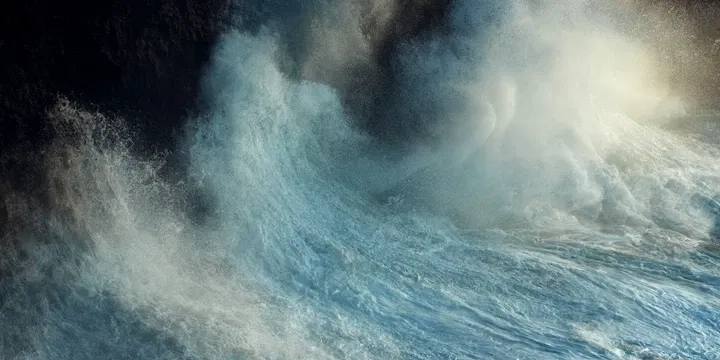
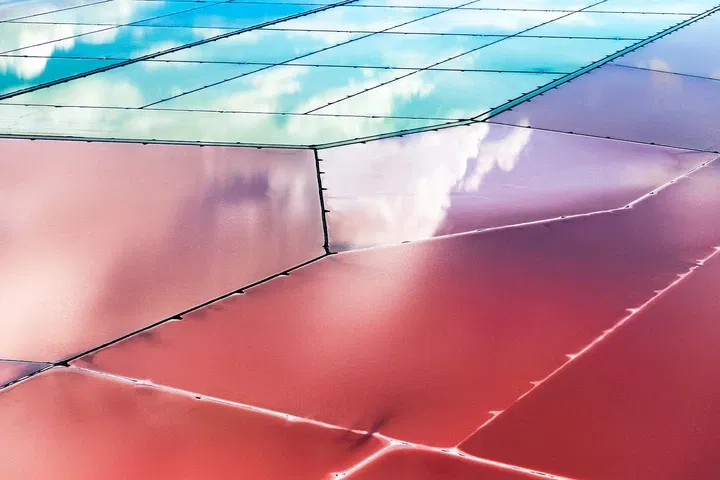
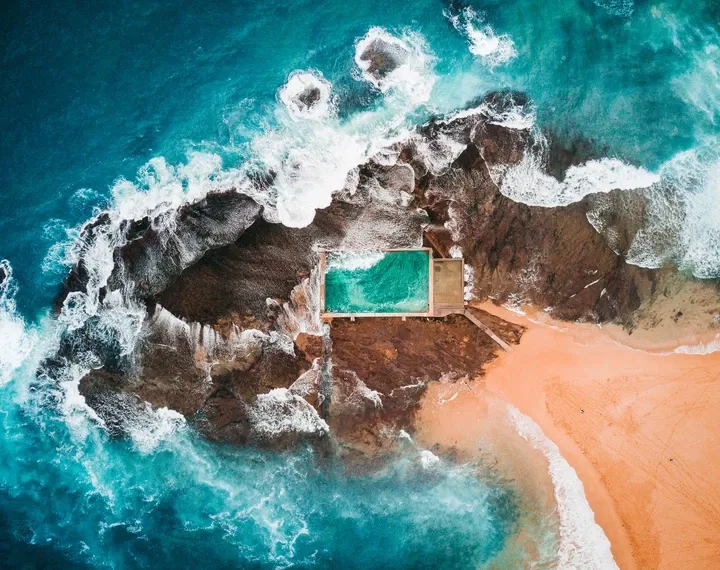
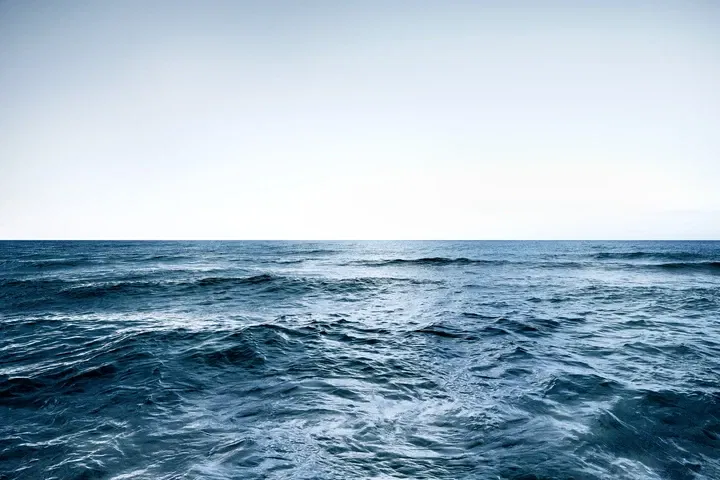
Born in Winnipeg in 1973, the Canadian photographer points his camera almost vertically towards the earth, stripping the familiar of its usual coordinates: the horizon disappears, spatial depth dissolves, rivers become lines, water becomes movement, landscape becomes colour and structure. What at first appears to be an abstract composition reveals itself only at second glance as real topography. It is precisely within this brief moment of disorientation that the distinctive power of his photographs lies — where seeing turns into recognition, and recognition once again into wonder.
Boyle’s landscape photography thrives on this interplay. Reality remains untouched, yet its perception is subtly shifted. From an extreme bird’s-eye perspective, he creates images whose organic forms can evoke painting or drawing just as readily as cartographic systems. Branching waterways extend across the surface like graphic networks, colours collide, sediments leave traces. The landscape loses its legibility as a place — and acquires a new one as an image.
Boyle’s fascination with this openness reaches back to his childhood. While daydreaming, he would look up at the clouds and see figures emerge, only for the wind to dissolve them moments later. It was not the form that dictated what could be seen, but the imagination. He transfers precisely this freedom to the landscape: the familiar emerges, then disappears again — reality remains, while its interpretation is left open.
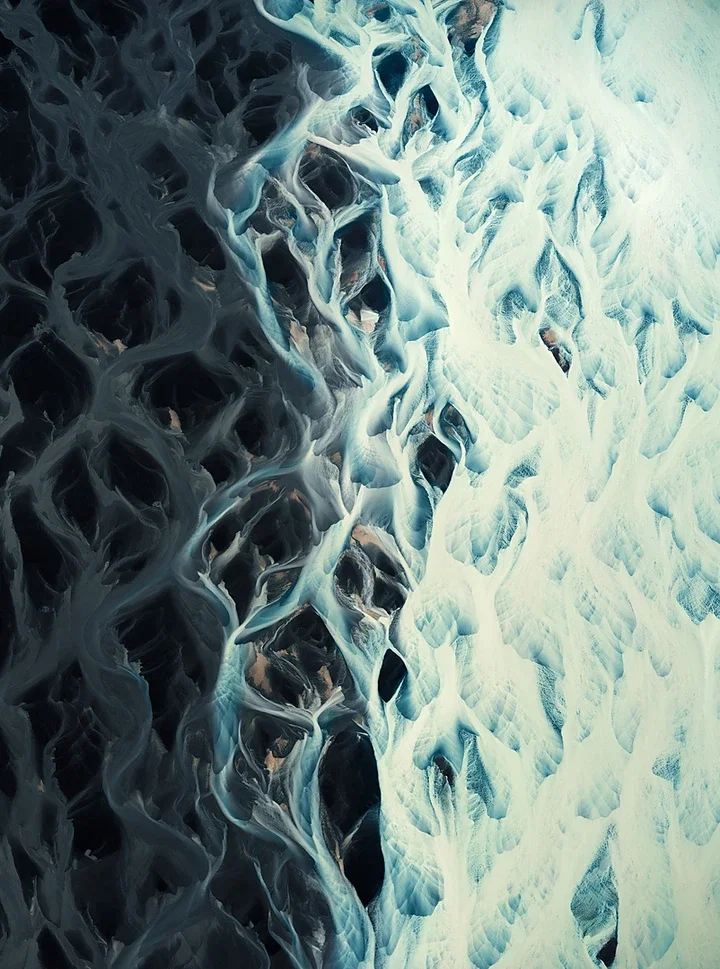
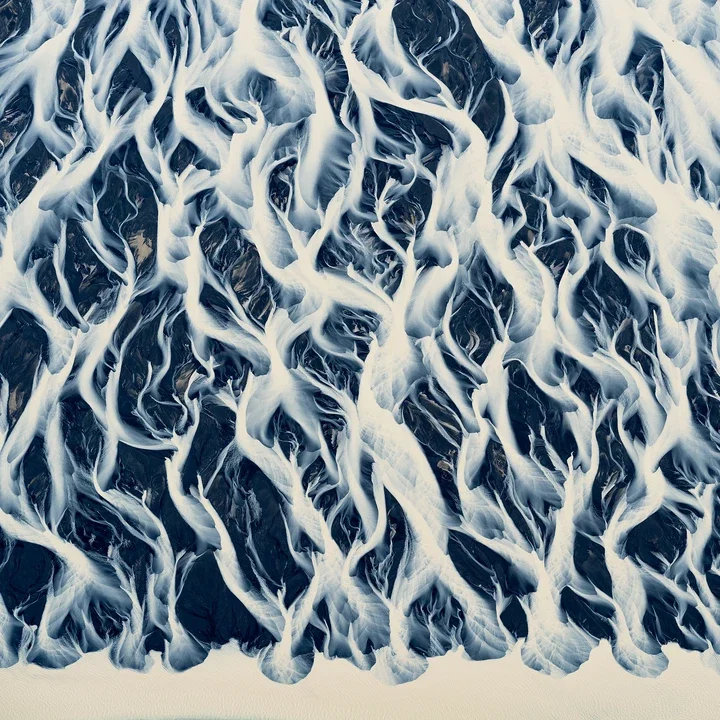
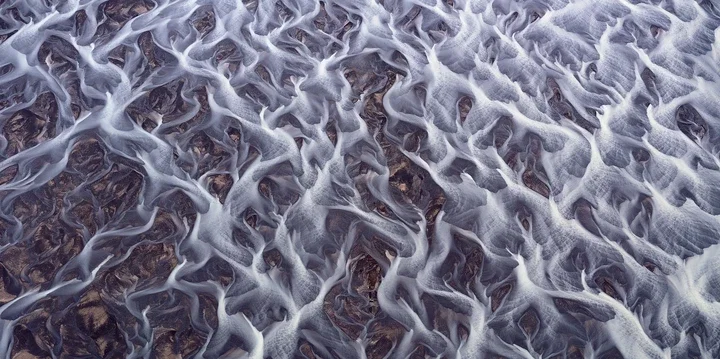
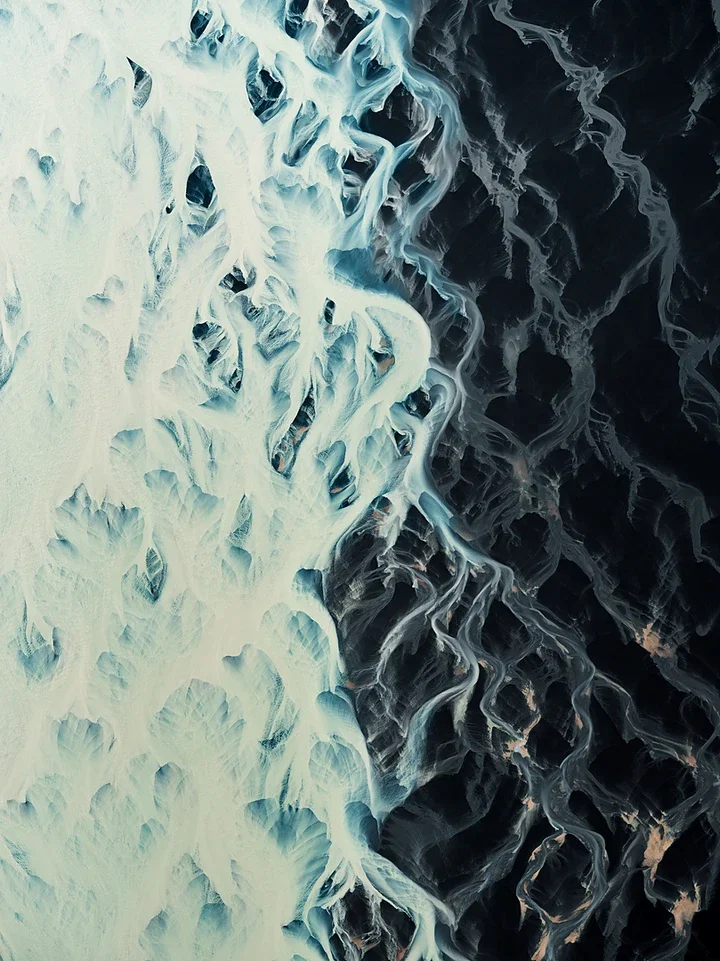
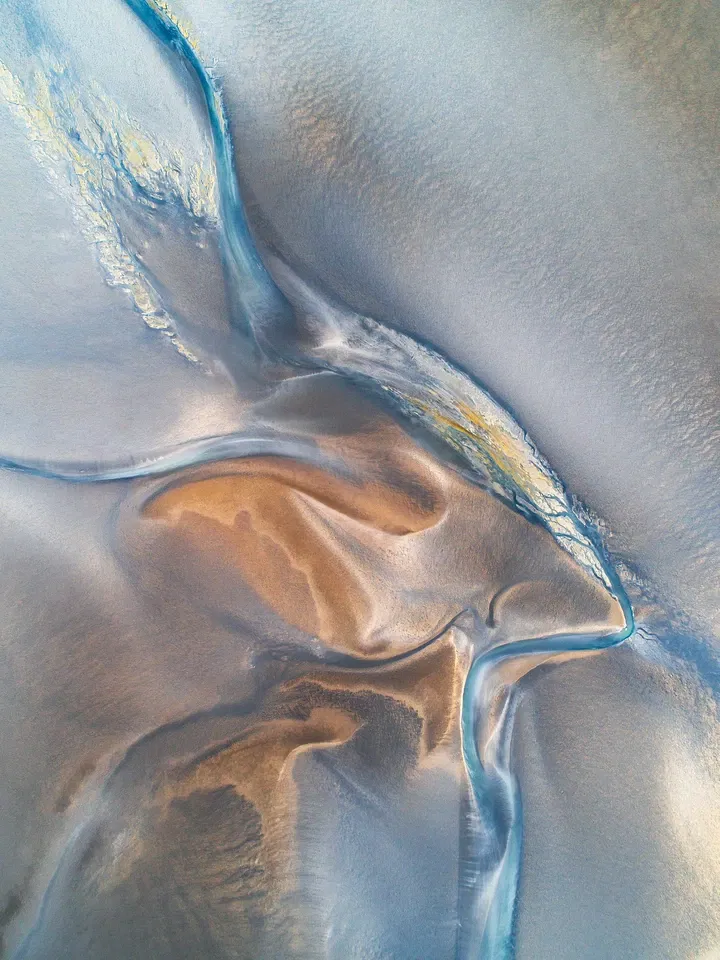
This approach is particularly striking in the works created in 2022 and 2023 along Iceland’s south coast, south of Skaftafell. Photographing from a Cessna at altitudes of approximately 3,000 to 4,500 feet, Boyle used a stabilised 100-megapixel medium-format camera. Yet this technical precision does not serve the spectacle of aerial photography, but rather a more exact way of seeing: it allows him to preserve the finest structures from a great distance and to translate the monumental landscape into a surprisingly immediate surface.
The four photographs continue the ideas explored in his series “Elemental”. At their centre are Iceland’s branching river systems, where glacial water spreads across the landscape, divides, and converges once more. In “Upstream” and “Downstream”, two views become visual counterpoints. Forms appear to respond to one another, pulling in opposite directions and creating a tension that stretches across the image almost like a tug of war. Nature appears here not as a static backdrop, but as an ongoing process.
In “Rain Dance”, this movement takes on an almost physical quality. Shortly before the glacial water reaches the Atlantic, its arms wind their way through the landscape. Seen from directly above, the twisting forms recall dancers moving across a surface — an association that does not need to be imposed upon the image, but emerges from its actual structures. Water becomes line, line becomes gesture. For a moment, the landscape seems to speak another language.
Boyle’s photographs do not call for a more spectacular view of the world, but for a more flexible one. They show that wonder is often only a shift in perspective away.
Kevin Boyle does not change the landscape, but the conditions under which we see it. By removing its familiar orientation, he gives our perception a new freedom.
Bio
Kevin Boyle, born in Winnipeg in 1973, found his way to artistic photography by an unusual route. The Canadian first learned to use the camera professionally while working in a police surveillance unit. Following the death of his father in 2011, a journey back into the vastness of the Canadian Prairies also led him towards photography as a form of artistic expression. The images he created along the way developed into his first exhibition; since then, Boyle’s work has been shown internationally and has received numerous awards. In 2015, his series “DaySleeper” was awarded, among other distinctions, first prize at the International Photography Awards in the Night Photography category. In 2026, Boyle was named a Hasselblad Master in Architecture.
Exhibitions
Solo Exhibitions
| 2025 | DaySleeper II, Studio 368, Vancouver |
| 2023 | Elemental | The Shape of Water, Christine Klassen Gallery, Calgary |
| 2022 | The Virtue of Solitude, Benjamin Lumb Art House, West Vancouver |
| 2021 | Perception, Vancouver Art Gallery | Art Rental & Sales, Vancouver |
| 2020 | Seattle Deconstructed Art Fair ~ Lithium & the New Energy, Hall Spassov
Gallery, Seattle |
| 2020 | Light, Shadow & Reflection, Winchester Galleries, Victoria |
| 2019 | Barrister’s Lounge, Art Rental & Sales Vancouver Art Gallery,
Vancouver |
| 2019 | Elements of Nature, Winchester Galleries, Victoria |
| 2019 | Elemental | Ice, Kimoto Gallery, Vancouver |
| 2018 | Lost Together | Exposure Photography Festival, Christine Klassen Gallery,
Calgary |
| 2017 | HERD, Gurevich Fine Art, Winnipeg / HERD, Hall Spassov Gallery, Bellevue /
HERD, Kimoto Gallery, Vancouver |
| 2016 | DaySleeper, Rouge Gallery. Saskatoon |
| 2016 | DaySleeper | Exposure Photography Festival. Christine Klassen Gallery, Calgary |
| 2015 | DaySleeper, Kimoto Gallery, Vancouver |
| 2015 | Prairie Works, Turnbull Gallery | Semiahmoo Arts & Recreation Center, Surrey |
| 2014 | Range: A Prairie Study, Kimoto Gallery, Vancouver |
| 2012 | Coast to the Prairies, Small Ritual Coffee Society, White Rock |
Group Exhibitions
| 2025 | Virtue of Solitude | Exposure Photography Festival, Christine Klassen Gallery,
Calgary |
| 2023 | Past, Present, Future, Christine Klassen Gallery, Calgary |
| 2023 | Heart to Heart, Van Dop Gallery, New Westminster |
| 2022 | Seattle Art Fair, Hall Spassov Gallery, Seattle |
| 2022 | IN SITU | Exposure Photography Festival, Christine Klassen Gallery, Calgary |
| 2021 | Summer Group Show, Winchester Galleries, Victoria |
| 2021 | Exposure Photography Festival, Christine Klassen Gallery, Calgary |
| 2020 | Grand Opening, Chase Edwards Contemporary, Delray Beach |
| 2019 | Art Market San Francisco, Hall Spassov Gallery, San Francisco |
| 2018 | Winter Wonderwalls V, Kimoto Gallery Vancouver |
| 2018 | Art Walk Salon, Kimoto Gallery, Vancouver |
| 2017 | Winter Wonderwalls IV, Kimoto Gallery, Vancouver |
| 2017 | TEN, Christine Klassen Gallery, Calgary |
| 2017 | Grand Opening, Finch Gallery Workspace, Winnipeg |
| 2017 | KG Artists Summer Show, Kimoto Gallery, Vancouver |
| 2017 | Canada 150 Group Show, Kimoto Gallery, Vancouver |
| 2017 | 7 Cameras, Christine Klassen Gallery, Calgary |
| 2016 | Put A Bird On It, Christine Klassen Gallery, Calgary |
| 2016 | Winter Wonderwalls II, Kimoto Gallery, Vancouver |
| 2016 | Ten, Gurevich Fine Art, Winnipeg |
| 2016 | CHROMA, Christine Klassen Gallery, Calgary |
| 2016 | CHROMA, Christine Klassen Gallery, Calgary |
| 2015 | Winter Wonderwalls, Kimoto Gallery, Vancouver |
| 2015 | Art Toronto Main Gallery (courtesy of Gurevich Fine Art), Toronto |
| 2015 | A Sense of Place, Gurevich Fine Art, Winnipeg |
| 2015 | Summer Mix Vol.2, Kimoto Gallery, Vancouver |
| 2015 | Range: Selected Works, Rouge Gallery, Saskatoon |
| 2014 | Members Exhibition, Turnbull Gallery | Semiahmoo Arts & Recreation
Center, Surrey |
| 2014 | 24×24 Group Exhibition, Kimoto Gallery, Vancouver |
| 2014 | Summer Mix Group Show, Kimoto Gallery, Vancouver |
| 2014 | Spring Group Show, Kimoto Gallery, Vancouver |
| 2013 | A Grand Opening, Kimoto Gallery, Vancouver |
| 2013 | The Art of Long Exposure, “Collens Hill Park”, Photohaus Vancouver,
Vancouver |
Interview
1. Picasso once said, “You don’t make art, you find it.” Where do you find your art?I had always been “artistic” in the way that I used sketching and drawing mainly to make fun any caricatures of my friends. I had friends that were professional artists but there was never a part of me that wanted to make art for myself. I learned to use a camera while working in a police surveillance unit, and I became proficient in photographing contract hitmen, suspects breaking into houses, robbing banks, and high level drug traffickers. In 2011, my father whom I was very close to, passed away. I became very homesick and drove two days from the west coast of Canada to the central Prairies, photographing expansive plains and abandoned buildings along the way. My photographs were seen online by a local gallery and they asked me to do a show, with the hanging date one year to the day of my father’s passing. I took that as a sign and from that point on I leaned into my artistic inclinations and continued to explore what I could do with a camera.
2. From the initial idea to the finished work: How do you approach the creative process?
I try and find inspiration in everyday life, whether it’s a painting I’ve seen or the way a building looks. In my aerial abstract work, Elemental and The Shape of Water, the idea for the works came from cloud watching as a kid. I used to lay on the grass and look up at the sky and imagine all the different shapes and animals being formed temporarily in the sky. With my aerial work I try to go to find places where I can change the perspective of the viewer so the landscape is relatable but not immediately recognizable, and allow the viewer the space to let their imagination wander.
3. What is your favourite book?
The Dark Tower by Stephen King. It’s a perfect example of the complex struggle of good versus evil from the perspective of an imperfect protagonist.
4. Which artist would you most like to have a coffee with, and what would you talk about?
I’m sure if you asked me this question in a month the answer would change, but at the current moment, maybe Nadav Kander. I love his work, and I appreciate how different his series are, refusing to be pigeon holed into a particular style. I would want to just talk about life in general and try and get an understanding of his inspiration while sharing my own.
Closely behind him would Edward Burtynsky, Gregory Crewdson, and Vic Muniz.
5. How did you first come to art?
At the earliest stage, I came into art by drawing my own comic books as a kid. My brother and I would create our own superheroes and craft stories and comics around their adventures. In the more modern version of myself, I remember visiting a painter friend of mines place and he had a painting of a monk stepping out of the shadows. The painting stuck with me to the point where I made a conscious effort to try and recreate that feeling with abandoned, small-town buildings, using long exposure photography and hand held flashlights. That painting with the inspiration behind the DaySleeper and Movieland series. I purchased the painting and it still hangs in the entrance of my house.
6. Which people around you have influenced you most?
My parents. My mom is the most supportive cheerleader at the age of 81, and her and my dad instilled a sense of freedom to explore my passions and not be afraid of failing. My dad lost most of his vision in World War II (he was 53 when I was born in 1973) and despite that he never complained or let it stop him from doing what he wanted. My biggest regret is that he didn’t live to see my work. As it turned out after going through his war photos, he was a photographer himself, using an old Rolleiflex to photograph his friends during the war.
7. Imagine you had a time machine. Where would you travel to?
The Mesozoic Era. I want to see dinosaurs, and try not to get killed.
8. What is your greatest passion outside of art?
Golf and Philanthropy.
Golf is a stupid game created by idiots, to attract other idiots into sharing their misery. But I love it.
I love giving back to the community (outside of policing), and am so proud to say that my work has raised over $200,000 for Canadian charities in the past 8 years. Honestly my most proud accomplishment.
9. What are you currently working on?
I’m working with Hasselblad to complete my Movieland Series which will fully launch in their Masters Book in 2027, and in my galleries shortly after that launch. My next series, which is already in the works will be on the impermanence of mankind, combining pristine landscapes superimposed into the windows of abandoned structures. The working title is “Everything Is Going To Be Just Fine”. I’m hoping for a 2028 launch.