Andrés Galeano rearranges the sky — and with it, memory.
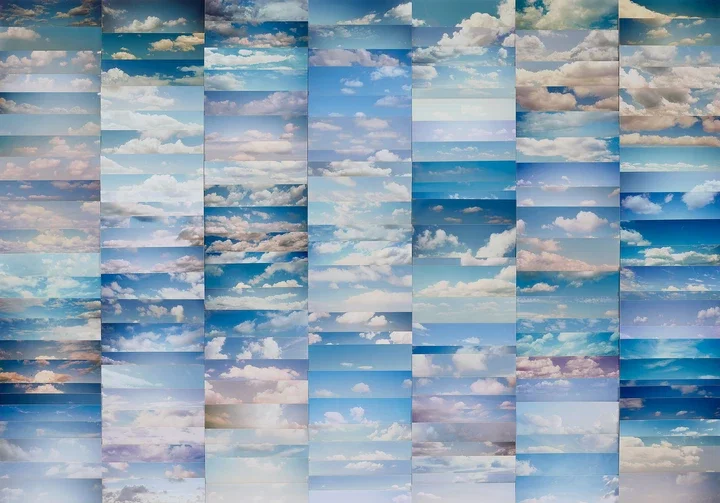
For more than 15 years, the artist has been collecting old photo albums, mostly from dissolved estates, which he discovers at flea markets. Removed from private image archives, the photographs have lost their original contexts. Galeano preserves them without cropping or altering them, assembling them according to geometric principles into new compositions.
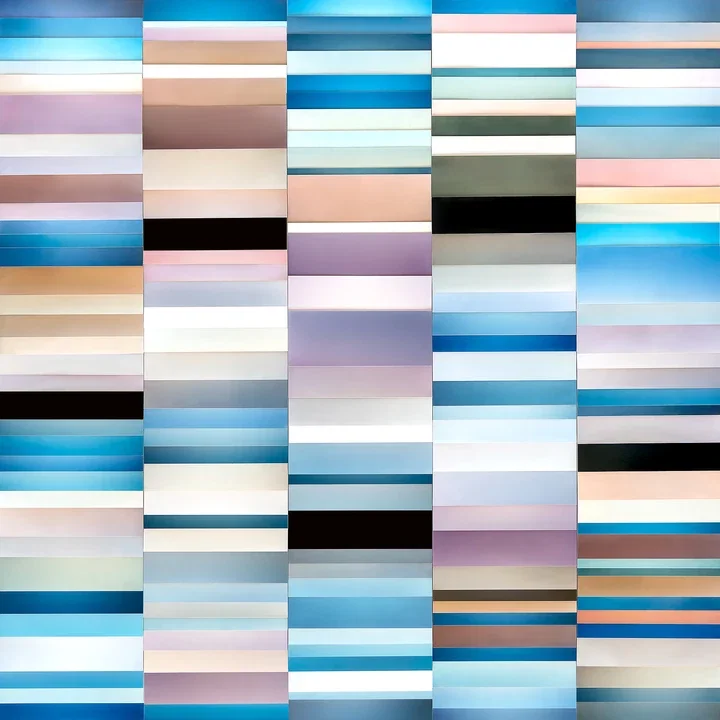
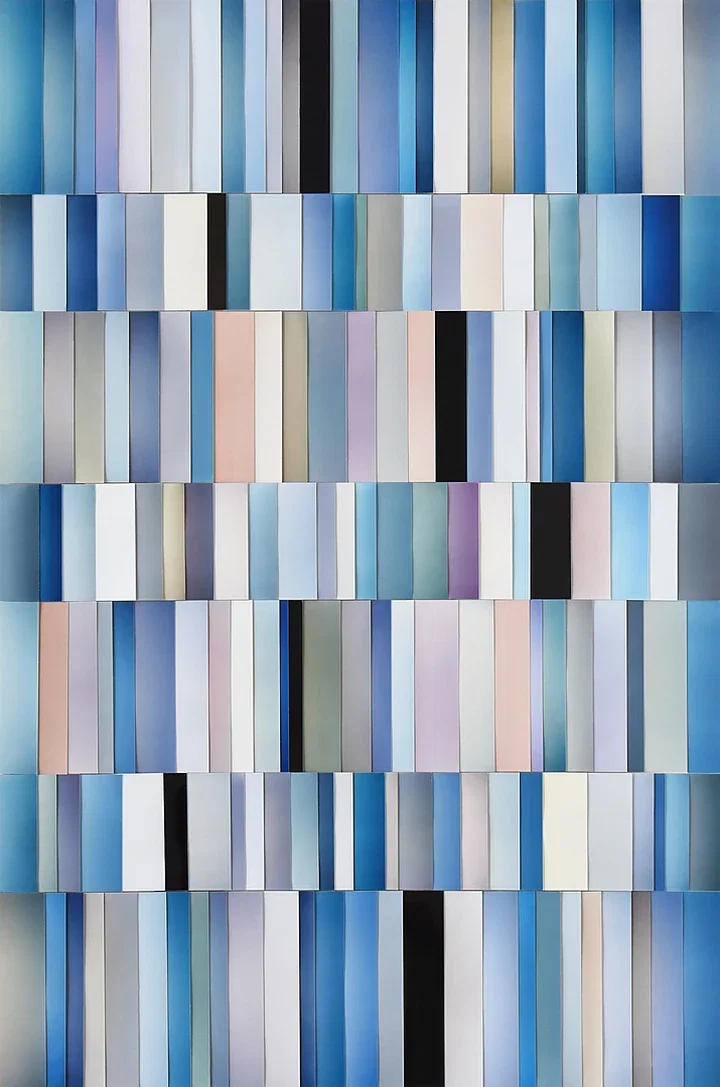
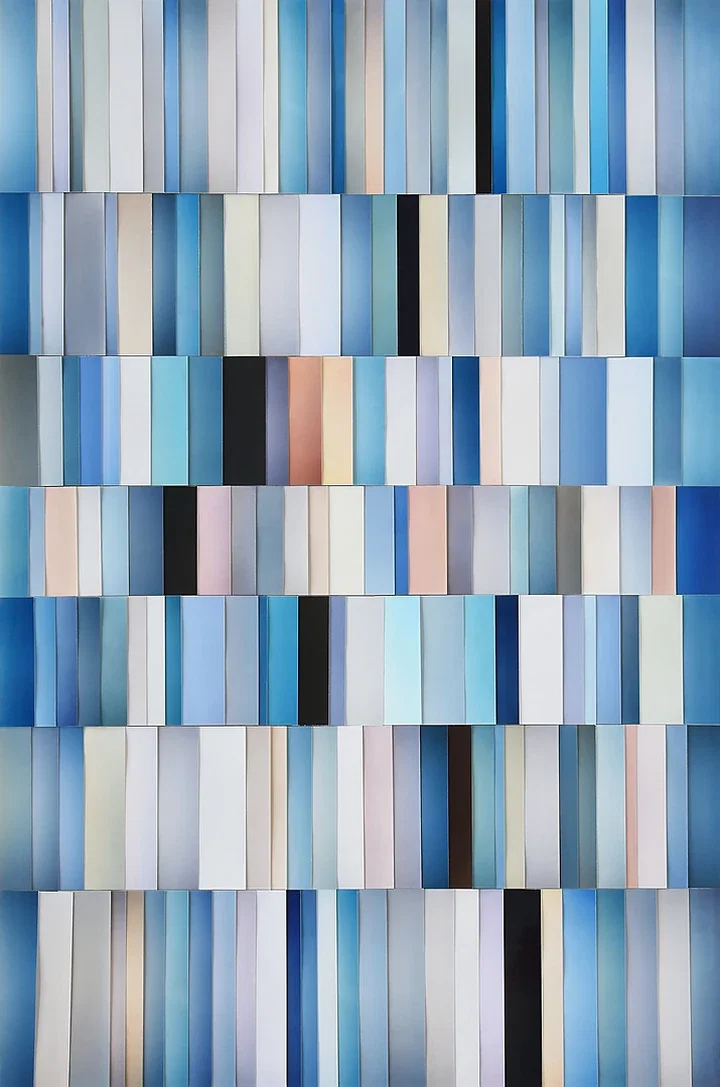
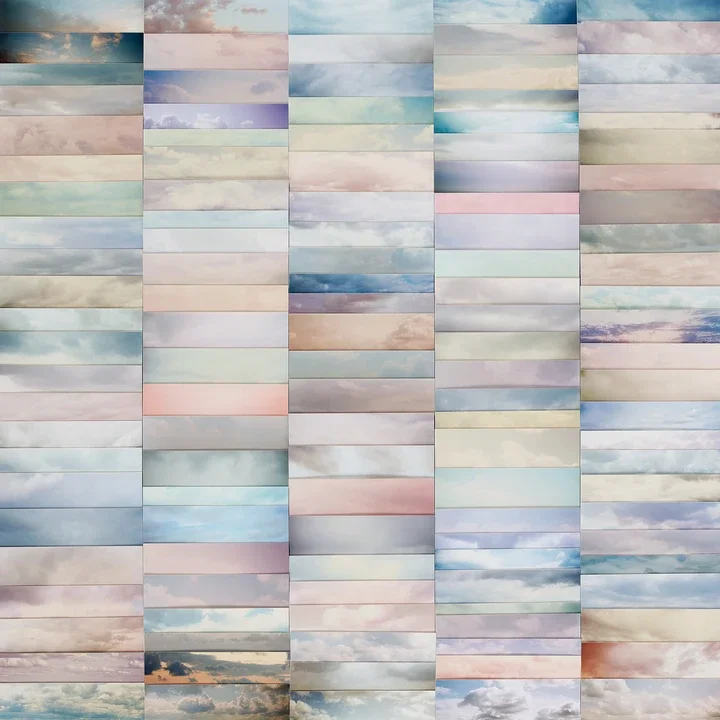
In this series, his gaze is directed consistently upwards. Narrow sections of sky are arranged into vertical bands, cloud formations meet unfamiliar horizons, and different shades of blue and qualities of light flow directly into one another. What originally belonged to different places, times, and biographies becomes one vast, polyphonic sky. The strict order of the grid holds together what, in reality, never belonged together.
It is precisely within this contradiction that the tension of the works lies: the fragmentary is brought together into a whole without denying its origins. Breaks remain visible between the individual photographs; sky continues into sky while changing in colour, light, and atmosphere. The composition appears both precisely constructed and almost boundless. In its geometric rhythm of colour, it recalls Paul Klee’s “Highways and Byways” — and his idea that art does not reproduce the visible, but makes visible. Galeano, too, does not invent a new motif. He changes the order of what already exists and, with it, the way we see.
The sky becomes more than a pictorial subject. As a primordial metaphor of transcendence, it connects the many photographs whose authors have become anonymous into a shared movement: everything seems to strive upwards. At the same time, each individual image remains a material relic — an analogue print that was once part of a personal memory and that continues to exist as such within the digital image worlds of our time. Galeano’s works thus move between preservation and letting go, memory and forgetting. They ask what remains of stories once their narrators have disappeared, and what role images can assume when they lose their original context.
Against this background, the fact that Galeano first studied philosophy in Barcelona before turning to photography in Stuttgart and Fine Arts at the Weißensee Academy of Art in Berlin seems almost inevitable. For around 20 years, he has worked across photography, drawing, video, installation, and performance; today, he lives and works in Berlin and Barcelona.
From many private skies and Unknown Photographers, Galeano does not create a new one — he makes visible what has long connected them. He invents by finding — and reminds us to look up.
1. Picasso once said, “You don’t make art, you find it.” Where do you find your art?At flea markets. I work with second-hand photographs. I adopt them and give them a new life in my studio.
2. From idea to realization: how do you approach your work?
The processes are very intuitive and differ from project to project. They usually begin with encounters with images or with a case study that fascinates me. It starts with fascination, followed by collecting and connecting materials and ideas, becoming obsessed with the subject, theoretical research, formal experimentation, conversations with friends and experts, writing about it, questioning the results, applying for grants, residencies or exhibitions, producing the work in the studio and, finally, exhibiting and publishing the project.
3. Your favorite book?
I don’t think in those categories. This is my library!
4. Which artist would you like to have coffee with, and what would you talk about?
I’d love to talk with Erik Kessels about vernacular photography, photobooks and humor.
5. How did you get into art?
The path is quite complex, but here is the short version: I first studied philosophy in Barcelona. During my studies, I engaged with authors such as Walter Benjamin, whose aesthetic ideas had a strong influence on me. Literature and film were also very important to me at the time, as was analogue photography, which I initially taught myself. After completing my philosophy degree, I moved to Germany to learn German. In fact, doing so made me more visual. I then studied fine-art photography systematically at an independent photography school in Stuttgart. Photography alone was never enough for me, however, so I went on to study Fine Arts at the Accademia delle Belle Arti in Bologna and at the Kunsthochschule Weissensee in Berlin.
6. Which people around you influence you?
Children make me a better person. Your inner child must always remain awake, curious and alive! I also really value exchanging ideas with other artists, because it influences your own practice and way of life. We are on the same wavelength and share a certain sensitivity, values, visions and enthusiasm.
7. Imagine you have a time machine. Where would you go?
To the year 2222.
8. Your greatest passion outside of art?
I would say “collecting photography,” but of course that is connected to my art… I’m also passionate about teaching art, but then again, that is related to art too… Let’s say: traveling!
9. What are you working on at the moment?
I’m currently developing a project entitled Natural Colors about the German photography company Agfa, the beginnings and popularization of color photography, and its influence on our photographic perception. At the moment, I’m designing a photobook for the project based on the Casa Planas archive in Mallorca and produced with the support of the Goethe-Institut. Hopefully, after four years of research, I’ll soon be able to exhibit this extensive project as well.